Radio City Products 665 VTVM · Volume 2
RCP 665 — Vol 2: Functional Spec, Warm-up & Care
The four functions, vacuum-tube warm-up discipline, and vintage-instrument care
2.1 Functional spec
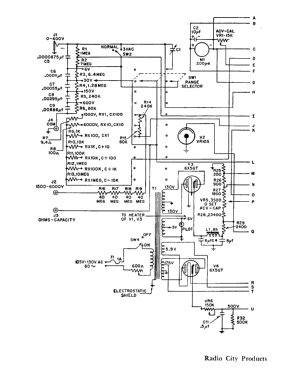
From the period advertisement and the Radiomuseum service notes:
Voltage measurement (VTVM function):
- 13 ranges total, AC and DC combined
- Lowest range: fraction of a volt (sub-volt resolution on the lowest scale)
- Highest range: 6,000 V (high-voltage probe required for full range)
- Input impedance: ~11 MΩ on DC voltage ranges (typical for the era’s VTVM topology)
- The AC voltage ranges use a copper-oxide or selenium rectifier in the probe; calibration is typically sinusoidal-RMS, derived from peak detection
Resistance measurement (vacuum-tube ohmmeter function):
- 7 ranges total
- Lowest range: a fraction of an ohm (down to ~0.1 Ω with the multiplier resistors)
- Highest range: 2,000 megohms
- The “vacuum-tube” qualifier means the measurement uses a bridge circuit with a tube as the comparator amplifier, giving useful resolution at the 100+ megohm range that a passive ohmmeter cannot reach
Capacitance measurement (capacitymeter function):
- 7 ranges total
- Lowest range: 2.5 mmfd (= 2.5 pF — the old unit, “micromicrofarad”; mmfd = pF in modern units)
- Highest range: 0.4 mfd (= 0.4 µF; mfd = µF)
- This is approximate; the typical use was identifying unmarked bypass caps and confirming the value of replacements
Insulation testing (megohmmeter function — the headline feature):
- DC test voltages from 500 V up to a stated 10,000 megohms full-scale (the test voltage may be selectable in steps; TBD — verify the exact step pattern against the service manual)
- Used for testing leakage in paper capacitors, transformer windings, and power-line insulation
- The high-voltage source is internal to the instrument and powered from the AC mains (so the instrument has no battery for this function — it’s mains-only for the megger range)
Physical:
- Rugged metal case (the period ad calls it “Rugged metal case — thorough shielding”)
- Dimensions: 9¾” × 12¼” × 6” (W × H × D)
- Weight: 13 lbs with batteries installed
- Carry strap or handle on top (visible in the photo in
RCP_422_665.jpg)
TBD — exact revision/variant of the 665. The Radiomuseum entry indexes the 665 as a single model; the period ad does not list sub-variants. However, RCP did periodically revise instrument designs over the production run (the 665 was sold from approximately 1942 through the late 1940s). The specific unit may carry a small revision tag on the rear chassis (a serial-number date code, a revision letter, or simply a date stamp on the inside of the case). Without that data point, treat the spec above as nominal.
2.2 Warm-up & drift discipline
The 665, being a vacuum-tube instrument, has a warm-up time of approximately 10-15 minutes from cold power-on to stable readings. The internal tubes (the exact tube complement varies by revision but typically includes a 6AL5 dual-diode for AC rectification, a 6SN7 or 12AU7 dual-triode for the bridge amplifier, and possibly a VR-150 regulator tube on later revisions; TBD — verify against the unit by removing the case bottom and reading the tube envelopes) need to reach their normal-operating-temperature emission state before the calibration adjustments (zero, ohms-zero, and AC-zero on the front panel) hold reliably. Powering up the meter, immediately zeroing it, and immediately measuring will give a reading that drifts over the next 10 minutes as the tubes stabilize.
The standard warm-up discipline is: power on, walk away for 15 minutes, return, zero the meter on each range you’ll use, then measure. Re-zero between range changes if the previous range was much different (going from a 1000 V range down to a 1 V range causes some divider settling). The drift after warm-up is small — fractions of a percent — but the warm-up transient is large.
Battery state matters for the ohms and capacitance ranges. The 665 uses internal dry-cell batteries (1.5 V and 22.5 V “B” batteries in the original design; TBD — verify whether the unit still has period batteries, has been retrofitted with modern cell substitutes, or has been adapted for an external supply) to source the ohms measurement current and the capacitance bridge excitation. Old or weak batteries shift the ohms-zero off the scale; replace them on a calendar schedule (annually) rather than waiting for them to fail. The 22.5 V batteries are no longer in commercial production but can be approximated with a 5-series stack of 9 V alkalines (which is ugly but works); the 1.5 V cells are standard D or C cells. The megger function (high-voltage insulation testing) is mains-powered and does not use internal batteries.
2.3 Care & storage
The 665 is a vintage instrument and should be treated like an antique radio:
- Bring it up on a Variac if it’s been off the bench for more than a few months. Like any tube gear, the electrolytic filter caps in the power supply may have lost form over years of disuse; bringing the AC voltage up slowly over 30-60 minutes reforms the dielectric and prevents the inrush spike from blowing the caps.
- Avoid the original line cord. 1940s-era rubber-insulated AC cords lose insulation flexibility over 80 years and develop hairline cracks. Replace with a modern grounded 3-wire cord (the 665’s case is metal and should be earthed for safety on the megger range, where 500 V is internally generated).
- Inspect the megger high-voltage components if the megger range hasn’t been used in years. The 500 V supply uses period paper-foil capacitors that may be leaky; a leaky filter cap on the megger HV rail can produce dangerous DC at the test leads with no warning. If the megger range is to be used, have a competent technician verify the HV supply with a clip-lead-into-known-load test before relying on the readings.
- Store dry, in the original case or a fitted box. The metal case is shielded but the meter movement (D’Arsonval-type analog galvanometer) is mechanically delicate and bumps over decades shift the zero. A periodic mechanical-zero check (every few months) is good discipline.
Comments (0)