Radio City Products 665 VTVM · Volume 1
RCP 665 — Vol 1: Provenance & Why a VTVM in 2026
Radio City Products of NYC, the 1944 insulation tester, and high-Z input impedance
The RCP 665 is the oldest instrument in this entire 25-volume project — a mid-1940s combined vacuum-tube voltmeter, ohmmeter, capacitymeter, and insulation tester manufactured by Radio City Products Company, Inc., of 127 West 26th Street, New York City. The instrument predates the operator’s amateur license by decades and predates the transistor by months. It earns its bench slot in 2026 for two reasons: it still works, and it does things a modern DMM does not.
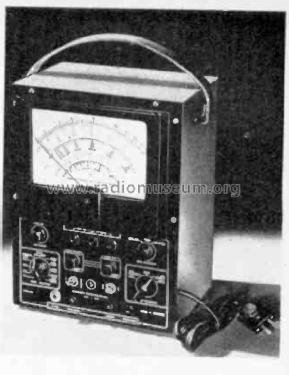
1.1 Provenance — Radio City Products Co. of NYC
Radio City Products Company was founded in New York in the early 1930s and operated through approximately 1970, when the company was wound down. The catalog spanned vacuum-tube voltmeters, volt-ohm milliammeters, signal generators, analyzers, tube checkers, and oscilloscopes — the full radio-service-shop inventory of the pre-transistor era. The 665 model was advertised in trade publications as early as October 1944 (the surviving period advertisement in this project’s 02-inputs/manuals/rcp-665/RCP_422_665.jpg is from Service magazine, October 1944, p. 25) at a list price of $79.50, billed alongside the smaller RCP Model 422 “Supertester” (a 27-function VOM at $29.50, unrelated to MFJ’s much-later 422D keyer despite the model-number coincidence). The 665’s RCP service-bulletin code is UTEL.
The 665 was marketed as an “Insulation Tester” — the megohmmeter / insulation-tester function was its headline feature for radio servicemen of the era, where the primary diagnostic question was often “is this paper-foil bypass capacitor leaky, and if so by how much” — answered by applying a known high voltage (up to 500 V on the 665) and measuring leakage current up to 10,000 megohms. The VTVM and ohmmeter functions were almost a bonus alongside the insulation tester for the price.
Documentation for the 665 in 2026 lives almost entirely on Radiomuseum.org (the German radio-collector reference site), which carries the schematic, the service notes, and the period advertisements. The two PDFs in the manuals folder are watermarked Radiomuseum exports; the schematic page is paywalled to Radiomuseum members ($20 EUR / $25 USD one-time membership for full access).
1.2 Why a VTVM matters — high-Z input impedance in a DMM era
The single technical reason to use a VTVM in 2026 is input impedance. A modern handheld digital multimeter (Fluke 87V, Brymen BM867s, Klein MM700) has a DC voltage input impedance of 10 MΩ on the higher voltage ranges. A VTVM has an input impedance of typically 11 MΩ on its DC voltage ranges (the canonical figure from the era) — slightly higher than the modern DMM, but the historical and topological point is that a VTVM’s input does not load the circuit at low voltage measurements because its input is a vacuum-tube grid (essentially infinite DC resistance) followed by a precision resistor divider, while a modern DMM’s input is a CMOS analog front end that may or may not present a clean 10 MΩ across the whole input range.
For radio work specifically, the use case is measuring DC voltages on a vintage tube radio’s grid circuits. A typical pentode RF amplifier (the 6BA6 in a 1940s broadcast receiver, the 6BJ6 in a 1950s communications receiver) operates with a grid biased at −1 to −10 V via a 1 MΩ grid-leak resistor. Measuring that grid voltage with a 10 MΩ DMM forms a divider: the 1 MΩ grid-leak in parallel with the 10 MΩ DMM input gives a measurement-time grid bias of 0.91 × the real bias — the meter is lying by ~10%. With an 11 MΩ VTVM the error drops to 8.3%, still nonzero but at least the direction-of-error is the same. For higher-impedance grid circuits (the 10 MΩ grid leaks in some VHF receivers, the 22 MΩ in some shortwave units), the VTVM’s advantage becomes more dramatic: a 10 MΩ DMM reads the voltage at half its real value; an 11 MΩ VTVM reads it at ~52%, still wrong but closer.
The bigger advantage of the VTVM is the probe. The 665 ships with a high-Z RF probe assembly that puts the rectifier diode and the divider network in the probe tip, not at the meter input. This means the meter cable does not see RF — it only sees the rectified DC envelope. A modern DMM with a clip-lead has the rectifier (if any) at the meter input, so any RF on the probe lead becomes RFI at the meter, distorting the reading. For RF voltage measurement at frequencies above a few hundred kHz, the VTVM’s probe topology is fundamentally better than a DMM’s, regardless of input impedance.
Comments (0)