Gigatronics 6060A Signal Generator · Volume 2
Gigatronics 6060A — Vol 2: Operating the Generator
Front panel + GPIB control, the receiver-alignment workflow, and bench wiring
2.1 Front panel & GPIB control architecture
The 6062A’s front panel exposes three numeric display fields — frequency, amplitude, and modulation — each independently keypad-addressable. The user-interface model is the classic 1980s synthesized-generator pattern: press a parameter key (FREQ, AMPL, AM, FM, ΦM, PULSE), enter a value on the keypad, press the units key (MHz, dBm, kHz, %, etc.). The “bright digit” can be incremented or decremented with arrow keys; a STEP-up/STEP-down pair walks programmed step sizes. Up to 50 complete front-panel configurations can be stored in non-volatile memory and recalled with two keypresses, and a SEQUENCE function steps through a programmed sequence of stored setups — useful for automated bench tests where one operator wants to walk a receiver across a span of test points without a controller.
The IEEE-488 (GPIB) interface is the production-test rationale for the entire instrument. Every front-panel control except the AC power switch and the rear-panel reference-source switch is remotely programmable. The instrument supports the standard IEEE-488 functions SHI, AHI, T5, TE0, L3, LE0, SRI, LRI, PP0, DCI, DTI, C0, EI — meaning it can be both talker and listener, can issue service requests, and supports remote-local lockout but does not have full controller capability (which it doesn’t need; in an ATE rack the controller is a separate PC or a dedicated GPIB controller). Two 6062As can be configured as master/slave for tracked frequency, amplitude, or modulation — useful for two-tone IMD testing where you want both generators to step in lock-step across a swept frequency.
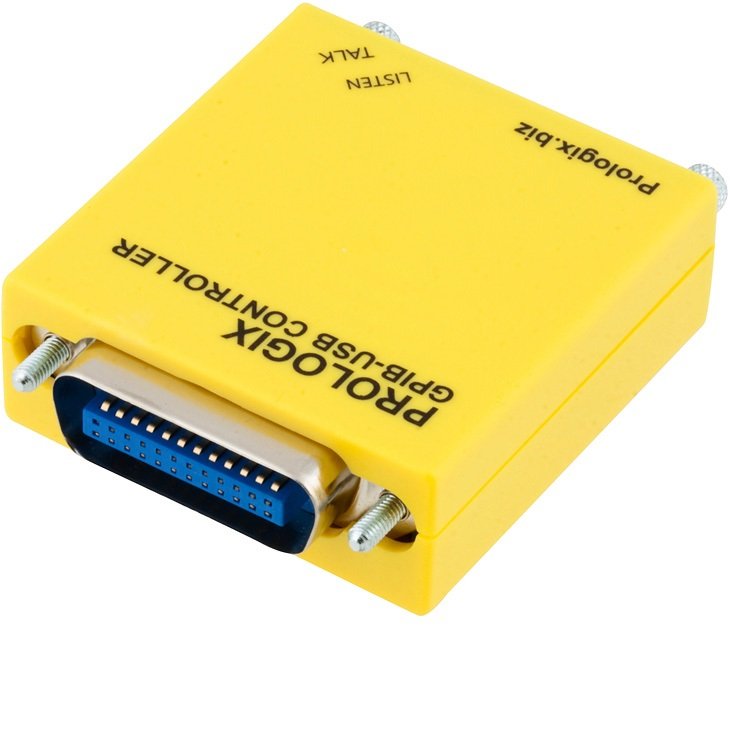
GPIB cabling reality, mid-2026: Native USB-to-GPIB adapters (Keysight 82357B, Prologix GPIB-USB, NI GPIB-USB-HS+) still work fine with modern Windows and Linux but driver support is patchy on macOS Apple-Silicon. For an on-bench hobby use case where the instrument is being driven by Python from a workstation, the Prologix GPIB-USB controller is the path of least resistance — it exposes a plain serial-over-USB endpoint that any pyvisa, raw socket, or even minicom session can talk to with text commands. The IEEE-488 cable itself is the rear-panel 24-pin Centronics-style connector with the offset mounting screws; vintage Hewlett-Packard / Keysight cables (HP-IB 10833A/B/C/D) interoperate without issue. TBD — confirm whether a GPIB cable + USB adapter is on the bench, or whether the unit is currently being driven only from the front panel.
2.2 Receiver alignment — the canonical application
The classic ATE application of the 6062A is calibrated-input receiver sensitivity measurement — feed a known input level (typically −121 dBm = 0.5 µV into 50 Ω) at the receiver’s IF center or a known RF channel, modulate at 1 kHz with ±3 kHz FM deviation, and measure the receiver’s audio SINAD (signal-plus-noise-plus-distortion ratio). The Uniden SDS100 and SDS200 (Vol 13, Vol 14) are the in-house benchmark targets for this measurement: factory spec is 12 dB SINAD at 0.3 µV (−117 dBm) on VHF NFM; an out-of-spec or out-of-alignment unit will need 0.5–1 µV to hit the same SINAD, which a Gigatronics + an audio analyzer (HP 339A, Audio Precision APx, or even an HP 3400A true-RMS voltmeter plus a notch filter) can resolve to about 0.5 dB.
The workflow is:
- Set generator to the target channel center frequency (e.g., 460.025 MHz for a UHF P25 site).
- Modulate FM, internal 1 kHz tone, ±3 kHz deviation (standard NFM test condition).
- Set output level to −121 dBm.
- Connect the generator output through a 20 dB pad and a known-good 50 Ω feedline to the receiver’s antenna port (use a coaxial dummy/coupler — not an over-the-air radiating connection, which gets you into FCC Part 15 territory).
- Measure the receiver’s discriminator or speaker-tap audio with a SINAD-capable analyzer.
- Sweep the input level up/down 5 dB while reading SINAD; the −121 dBm point should yield 12 dB SINAD if the receiver is in spec.
For aligning AM aero band receivers (108–137 MHz) the same workflow applies with AM modulation at 30% depth, 1 kHz tone. For aligning SSB receivers at HF (the X6100 in Vol 9) the generator runs in CW mode (no modulation) and the audio measurement becomes the BFO-product tone level — a measurement that’s straightforward but needs a generator that doesn’t itself have audible residual FM, which is why the 6062A’s <12 Hz residual is the load-bearing spec there.
For two-tone IMD testing (third-order intercept measurement on a receiver), the 6062A’s slave mode can pair it with a second 6062A or a different generator (an HP 8657B or Marconi 2024 works fine) feeding through a hybrid combiner. Two CW carriers at +20 dBm each, spaced by 20 kHz, combined and attenuated to ~−40 dBm at the receiver input, will produce a measurable IM3 product 20 kHz on either side of the input pair if the receiver’s third-order distortion can be resolved.
2.3 Bench setup & typical wiring
A clean Gigatronics bench setup for radio work looks like:
[Gigatronics 6062A RF OUT]
  → [20 dB pad, 50 Ω, ≥10 W]
  → [coaxial bidirectional coupler or hybrid combiner]
  → [50 Ω attenuator step, 0-110 dB in 10 dB and 1 dB steps]
  → [low-loss N or SMA cable, ≤1 m]
  → [DUT antenna port]
The 20 dB pad protects the generator from any reverse RF and absorbs the inevitable mismatch when a receiver’s antenna port is not exactly 50 Ω. The step attenuator lets you walk the input level by known calibrated increments without retyping numbers on the front panel (saving the generator’s relay count and giving you a faster sweep). The bidirectional coupler (e.g., a Mini-Circuits ZFDC-10-1) lets a spectrum analyzer or power meter tap the line for an independent measurement of what’s actually getting to the DUT — useful for catching cabling loss surprises.
For pulse-modulation testing (radar receiver characterization), the 6062A’s pulse-in jack accepts TTL drive from a function generator (Stanford DG535, BK 4054, or any modern AWG); set pulse rates from DC to 16 MHz with arbitrary duty cycles. The generator’s internal pulse generator can do 400 Hz or 1 kHz at 50% duty as a quick check without external hardware.
RF leakage spec is 0.5 µV (6061A) or 1 µV (6062A) at carrier frequency — meaning the generator’s case radiates that level even with no output cable. For sensitivity work near the radio noise floor (~−130 dBm), this is the limit on how close the generator can sit to the DUT before its own case-leakage becomes the input signal. Practical answer: keep the generator at least 3-4 feet from the receiver, especially if the receiver has any kind of HF longwire still connected.
Comments (0)